- supercars.test
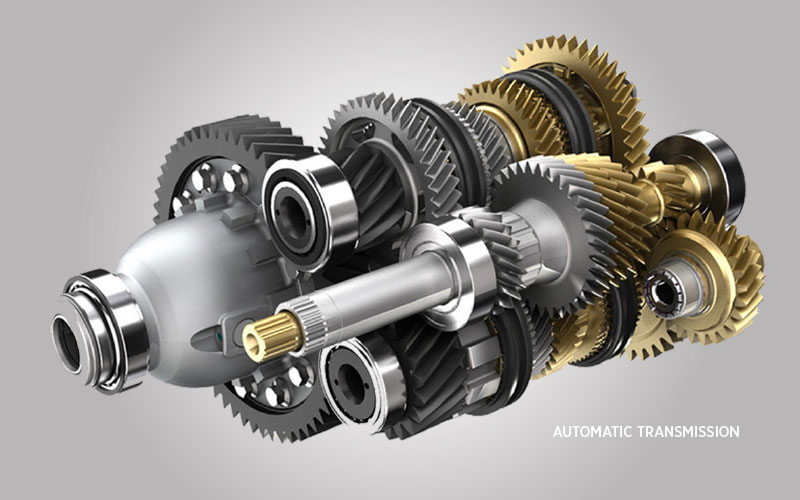
A car’s transmission is what moves power from the engine to the wheels, allowing the car to move. The gear, the ratio between the crankshaft and the driveshaft speeds, determines how much energy is transferred to the wheels. Each transmission system achieves this ratio differently.
In this article, we’ll discuss whether the continuously variable transmission (CVT) or an automatic transmission is better at selecting gears.
AUTOMATIC TRANSMISSION
An automatic transmission uses hydraulic power to shift the teeth of the gears without a driver’s input. It converts energy into transmission fluids that spin the car’s central shaft via a torque converter.
Whereas a manual transmission lets the driver change gears by actively engaging/disengaging the clutch, the torque converter in an automatic transmission does this autonomously.
CVT TRANSMISSION
The CVT is a type of automatic transmission. Pioneered by Leonardo da Vinci some 500 years ago and realized by Subaru in 1989, CVTs drive through a spectrum of gear ratios using one of three methods.
TYPES OF CVTs
PULLEY-BASED CVT
The pulley-based CVT has three main parts:
- An input pulley (connected to the engine)
- an output pulley (connected to the driveshaft)
- a belt.
Each pulley has two cones sliding along a connecting groove. The belt rides along this groove and connects the input to the output pulley. The pitch radius is the distance between the centre of the pulley and where the belt contacts the groove.
When the cones come closer, the belt rides higher in the groove at a larger pitch radius.
As one pitch radius increases, the other shrinks. The belt spins along a variable-length groove so there is an infinite combination of input-output radii. The result is a fluid ratio of gears at each speed.
TOROIDAL CVT
Toroidal CVTs use two discs and rollers to transfer energy between the engine and wheels. Speed increases when the rollers touch the input disc near its rim. Deceleration happens when it contacts the input disc near the centre.
HYDROSTATIC CVT
In a hydrostatic CVT, rotational energy from the engine reaches a hydrostatic pump on the input side. The pump converts this to a fluid flow that transmits to the output pump.
Here, it converts into a rotational flow to move the driveshaft at desired speeds.

THE MAIN DIFFERENCES BETWEEN CVT AND AUTOMATIC TRANSMISSION
- An automatic transmission has a lock-step gear that engages autonomously. CVTs have no gears.
- CVTs can provide a limitless number of gear ratios. Automatics offer a set number of gear options.
- CVTs can also adapt to automatic transmissions; the reverse is not possible.
WHICH IS BETTER
- Automatics are cheaper, easier to maintain and create a better driving feel.
- CVTs convert engine power to speed more efficiently by creating limitless gear ratios. They are lighter, offer superior fuel efficiency, and create a smoother ride.
- CVTs may have a shorter life span as they suffer from overheating, shuddering, and sudden loss of acceleration. They also generate a loud droning noise.
- Their rubber belts often slip or overstretch, causing the transmission to fail, though newer steel-banded versions are superior.
EXAMPLES OF THE BEST CVT CARS
Here are some examples of the best CVT cars you can buy:
- Toyota Rav4
- Toyota Corolla
- Toyota Camry Hybrid
- Honda CV-V
- Honda Jazz
- Nissan Altima
- Mitsubishi Outlander Sport
- Subaru Outback
- Subaru Forester
- Hyundai Elantra
- Kia Soul
- Lexus RC
Check out our blog for more exciting articles like this one, and stay tuned for more!
SHARE
Recent Post
Here’s why the Renault Koleos should be your next family car, and why it’s our car of the monthJanuary 1, 2023
Magic Carpet Feel” – What Makes The C4 So Comfortable and SmoothDecember 13, 2022
The Signature of Citroën: The Impressive Lighting Package Of The C4 CactusDecember 13, 2022
All The Cool Features Of The Citroën C4 Cactus’s Center ScreenDecember 13, 2022
Have Any Question?
If you have a question, call or email us.
We will get back to you as soon as possible!
Categories
Videos
Texts
Guides
Grand Prix